Artificial intelligence has changed the way a company can imagine, present and communicate its products. It is no longer a technological curiosity: it is a working tool that, in the right hands, lets you see sooner, decide better and communicate more.
Studio Tamoni has designed packaging and communication for pharmaceutical, food and cosmetic companies since 1983. Today we combine that experience with generative artificial intelligence, offering clients possibilities that only a few years ago required weeks of work and significant budgets.
Seeing packaging before it exists
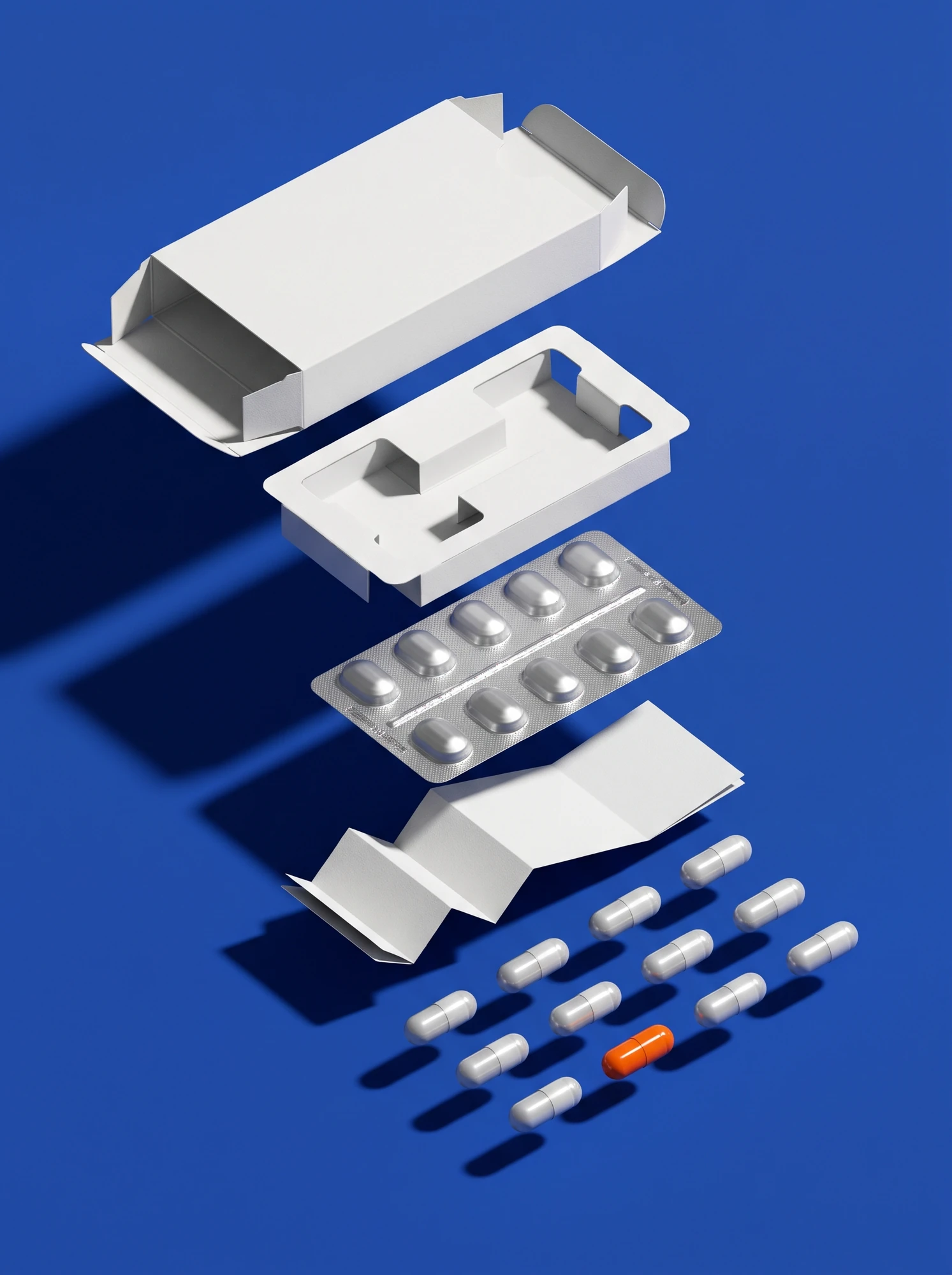
This is perhaps the biggest change for companies developing new products. A new line of supplements, the redesign of an OTC medicine, a Christmas gift box, a limited edition: today we can show them in photorealistic images before they go to print.
Cartons, bottles, blisters, jars and displays are visualised as they will really look, with convincing materials, finishes and light. Marketing teams can compare several proposals, evaluate colour variants and present the project to the sales force, medical reps, retail buyers or pharmacies. Decisions are made with the product in front of you, not on a technical drawing.
In pharmaceutical packaging this means saving time without sacrificing rigour: statements, brand colours and proportions remain those of the approved design.

Product images without the limits of a set
Once the product is defined, the possibilities are wide. The same pack can be placed on a pharmacy counter, in a bright kitchen, in an elegant bathroom, outdoors among herbs and fruit, or on a minimal studio set. In winter or summer versions, for the website, e-commerce, marketplaces or social media, in the formats each channel requires.
For a company with many products, this finally means consistent images across the whole catalogue, refreshed over time without organising a new shoot each time.
Freer advertising campaigns
Artificial intelligence opens creative space that traditional photography reaches only with large productions: products suspended among their ingredients, packs that open to reveal their contents, settings impossible to build in a studio.
We can develop several concepts for the same campaign and let the client choose, seeing the finished result. Key visuals for trade fairs and conferences, point-of-sale material, billboards and print ads are created with more ideas and fewer constraints.
Products that come to life
The same images can become short videos: a rotating pack, an ingredient falling in slow motion, a scene coming to life. This is the content that performs best today on Instagram, Facebook and digital campaigns, and until recently it required dedicated filming and post-production.
Social media with continuity and identity
An editorial plan needs new images every week. With artificial intelligence we can build a true visual system for each brand: palette, mood, framing and style that stay recognisable post after post. The result is a consistent, curated presence, without the repetition that comes from always using the same photos.
It is the method we use every month to manage the social profiles of pharmaceutical and food brands.
Websites and materials, faster
Artificial intelligence also speeds up the development of websites, landing pages, catalogues and multilingual materials. The time saved on repetitive tasks goes back into the project: more care for content, user experience and visibility on search engines and AI assistants.
Why experience makes the difference
AI tools are available to everyone. The results are not. An effective image comes from an idea, from art direction and from an eye able to spot what's wrong: an off-tone colour, a wrong proportion, a detail an attentive consumer would notice at once.
Anyone who has designed packaging for medicines, supplements, medical devices and food for over forty years knows that every element matters in these sectors. That is why at Studio Tamoni artificial intelligence does not replace the designer: it amplifies their experience. Every image is designed, directed and checked, and the product always stays true to the real one. We work in compliance with European and Italian rules on generated content and copyright.
What changes for your company
- Faster turnaround, from concept to delivery.
- More alternatives to choose from before investing in production.
- Consistent images across the whole catalogue and every channel.
- More efficient budgets, especially when many variants are needed.
- More creative freedom, without the limits of a physical set.
How we work
- Listening. We start from objectives, the brand and approved materials.
- Concept. We propose visual directions and settings to evaluate together.
- Production. We create images, video and content with artificial intelligence and professional design tools.
- Review and delivery. Every file is checked and delivered in formats ready for print, web and social.
Let's talk
If you are preparing a new product, a redesign or a campaign, we can show you what designer-led artificial intelligence can do for your brand.
Frequently asked questions
What can artificial intelligence do for my company's packaging?
It lets you visualise new packs, redesigns and special editions photorealistically before print, create product images in any setting and develop campaigns, video and social content consistent with your brand.
Are AI images suitable for the pharmaceutical sector?
Yes, when the work is led by people who know the sector. At Studio Tamoni the product shown stays true to the approved packaging and every image is checked before delivery.
Does artificial intelligence replace product photography?
In many cases it complements it or makes it leaner: it is ideal for variants, settings, social content and previews of new products. For some projects photography remains the best choice, and the two can work together.
How long does it take to get the images?
It depends on the project, but turnaround is generally much shorter than a traditional photo production, especially when many variants of the same product are needed.
Do you only work with companies in the Vicenza area?
No. The studio is based in Schio, in the province of Vicenza, and works with companies throughout Italy and abroad.
Let's talk.